A Send-Off That Reflected a Life of Giving
Minh Tran had operated a fresh produce stall at the Toronto Farmers' Market in the city's east end for more than two decades. He was not famous outside his neighbourhood. He did not hold public office or run a large company. What he had built, quietly and over many years, was something harder to quantify: a reputation for generosity that reached across the Vietnamese-Canadian community in Scarborough and into the broader network of vendors, customers, and neighbours who had encountered him over the course of an ordinary working life.
He extended credit to struggling families during hard months. He helped new vendors get set up at the market when they arrived with little knowledge of how things worked locally. When people in his building or on his street were going through difficult times, he arrived with groceries and left without making a point of it. Those who knew him describe these habits not as acts of occasional charity but as a consistent, almost reflexive response to need — the way some people think of generosity as something done once in a while, and others simply live it.
When he died, his children decided the tribute needed to be on the same scale as the way he had lived. Quiet and private would not have reflected him accurately. Something large, impractical, and impossible to ignore — that was more his register.
What Happened Outside the Funeral Home
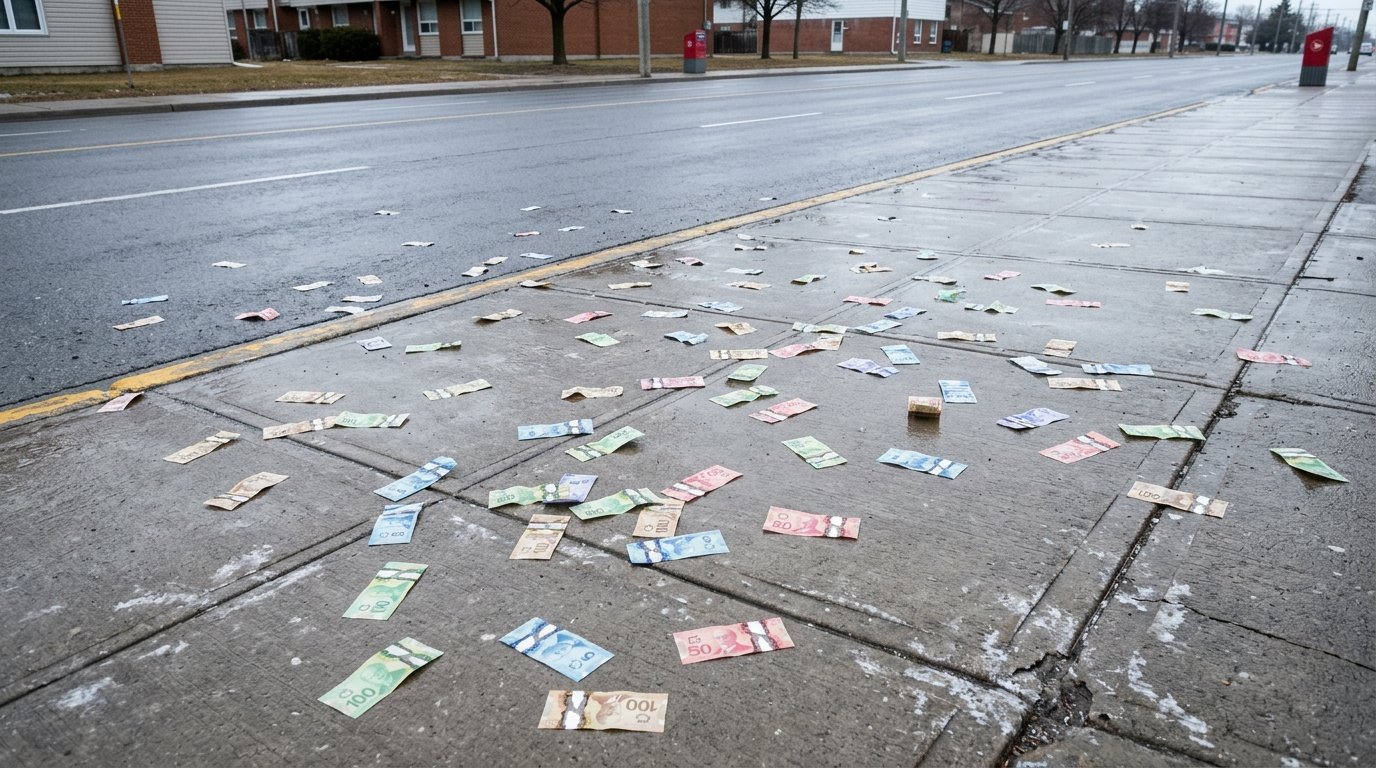
On a Saturday morning in late February, family and friends gathered outside the funeral home in Scarborough for the service. As the crowd assembled, a helicopter appeared low overhead — lower and slower than most people expected. First came wildflowers: trilliums and goldenrod drifting down across the crowd in loose clusters, catching the winter light as they fell. Then came cash — bills scattered from the aircraft that caught people completely off guard.
The moment lasted perhaps forty-five seconds from when the helicopter was first clearly audible to when it banked away. In that time, it generated footage that was captured from multiple angles by attendees with phones and shared to social media within the hour. By early afternoon the clips had spread far beyond Scarborough, attracting hundreds of thousands of views and generating commentary from across the Greater Toronto Area and beyond.
"He always believed that generosity should be visible and that money was most useful when it reached people who needed it. The helicopter was entirely his kind of gesture — large, impractical, and impossible to ignore."
— Minh Tran's family, in a statement to local media
Tran's children confirmed afterward that the tribute had been planned deliberately and at some cost. Their father had spoken over the years about how visible generosity normalised giving — that people were more likely to be generous themselves when they saw it done publicly and without embarrassment. The helicopter, in that sense, was not showmanship. It was philosophy.
How the Community Responded
Those who attended the service described the moment as entirely in character. Several long-time market colleagues said they had known something unusual was planned, though not what specifically. Tran was not a prominent public figure in the formal sense — he had never sought recognition and was uncomfortable when it was offered. But within Scarborough and the surrounding Vietnamese-Canadian community, he was known as someone who gave without keeping score and who showed up when showing up was what mattered.
The community response to the viral footage was notably warm. Comments from strangers who had never met Tran focused not on the spectacle but on what it represented — a man who had the resources to do something meaningful with money and chose to do it at the moment his family were saying goodbye to him. Several community members who caught bills outside the funeral home used them to donate to a local food bank in Tran's name, a gesture his children described as the most fitting response they could have imagined.
The Vietnamese-Canadian community in Scarborough is one of the largest and most established in Canada, with roots stretching back to the refugee arrivals of the late 1970s and 1980s. Within that community, the response to the tribute reflected a broader cultural value: the idea that a person's legacy is best expressed through the impact they had on the people around them, and that commemorating that legacy publicly is not vanity but respect. Several community leaders offered brief comments acknowledging that the tribute had resonated well beyond cultural lines.
Transport Canada's Review
Toronto Police confirmed they are not treating the incident as a criminal matter. Transport Canada opened a routine review of the flight following media coverage of the incident. A spokesperson stated that while the charter operator had filed the required flight plan in advance, the specific activity of dropping objects from the aircraft had not been included in the filed authorisation.
Under the Canadian Aviation Regulations (CARs), dropping objects from an aircraft requires specific authorisation and is subject to conditions designed to prevent risk to persons or property on the ground. The review is focused on compliance with those regulations and is not expected to result in any action against the family. The charter operator involved cooperated fully with the review process and provided documentation of the pre-flight planning that had taken place.
Aviation compliance note
Dropping objects from aircraft in Canada requires authorisation under the Canadian Aviation Regulations. Pilots and operators must take reasonable precautions to ensure that the activity does not endanger persons or property. Wildflowers and paper currency, scattered at low altitude over a contained gathering with advance coordination, fall in a legally ambiguous category that Transport Canada reviews on a case-by-case basis.
Other Extraordinary Farewells in Canadian History
The Tran family's tribute is unusual but not entirely without precedent in Canada. Extraordinary send-offs have occasionally marked the passing of community figures who were known for their generosity or larger-than-life personalities.
Nova Scotia Fishing Community Tributes
In several Nova Scotia fishing communities, the tradition of bringing the community together at the water to mark a fisherman's death — sometimes with a boat procession, sometimes with the scattering of flowers at sea — reflects a similar impulse: that the farewell should reflect the way the person lived. These traditions are deeply embedded in Atlantic Canadian coastal culture and are treated as community events rather than strictly private family affairs.
Indigenous Memorial Practices
Many First Nations communities across Canada observe memorial practices that involve communal gathering, the giving of gifts, and public acknowledgment of the deceased's contributions to the community. Potlatch ceremonies among Northwest Coast peoples, where goods are distributed among guests as an expression of the host's standing and generosity, carry an analogous logic to what the Tran family organised — generosity expressed publicly as both tribute and teaching.
Chinese-Canadian Funeral Traditions
Within Chinese-Canadian communities, particularly in Vancouver and Toronto, it is traditional to burn ceremonial paper money (known as joss paper) at funerals to provide the deceased with resources in the afterlife. The Tran family's gesture of distributing real currency can be understood partly within this broader cultural context of associating money with care, respect, and provision — expressed in a form visible and meaningful to the multicultural community their father had served.
The Social Media Effect
The footage from the funeral spread in the way that certain moments do — not because they are sensational in a disturbing sense, but because they are genuinely moving and unexpected at the same time. The clip showed something that people rarely see: a family honouring a person who gave, by giving. The response was almost entirely positive, and the comment sections across multiple platforms were notably free of the cynicism that often accompanies viral content.
Several journalists and cultural commentators noted that the moment resonated in part because it happened in a Canadian city that often sees generosity discussed in policy terms — housing affordability, healthcare funding, social support — and rarely witnesses it expressed so directly and personally. The helicopter over a Scarborough funeral home became, briefly, a different kind of image of the city: not a skyline or a landmark but a community moment, specific and human.
What Happens to the Money
A common question in the days following the incident was practical: what happens to cash scattered in a public space? In Canadian law, found money in a public place is technically subject to reporting requirements — finders of lost property with a value over a certain threshold may be expected to report it to police, who will hold it for a specified period before it can be claimed. In practice, for a clearly deliberate distribution of this kind at a private event (even one that attracted public attention), no such obligation typically applies. Several attendees confirmed they used the bills they caught to make donations in Tran's name, which his family described as the best possible outcome.
The cost of the tribute — the helicopter charter, the flowers, the planning — was covered entirely by the family and was, by their account, a considered decision rather than a spontaneous one. They had discussed it for weeks before the service. Their father had not left specific instructions, but they felt confident they understood what he would have wanted: something you could not miss, and something that ended with people having a little more than they had before.
In that sense, the tribute was consistent with the life it was meant to honour. Minh Tran spent decades making sure that the people around him had what they needed. On the day his family said goodbye to him, they arranged for that to happen one more time.